Driving theory test — Uganda (2026): format, pass mark and free practice
What you need to know to pass the theory test (Uganda) the first time, plus 19 practice questions with answers.
Take the free testThe test
Uganda’s theory test is taken online and marked automatically — you need 75% to pass.
50 questions. You need 38 correct answers to pass.
The exact format is not officially published: these figures are indicative, based on public information.
- Fail it and you go back through driving school before you can try again.
- Testing is moving fully to computers — practise in the same format.
Topics to revise
ITOZE’s 151 questions for this country cover:
- Road signs (47)
- Rules of the road (24)
- Licensing (20)
- Alcohol and dangerous driving (15)
- Accidents and breakdowns (12)
- Speed (8)
- Police and emergency (7)
- Vehicle and loads (7)
- Motorcycles and bicycles (6)
- Lights (5)
How to prepare
- Start with a test to see where you stand.
- Revise topic by topic, reading the explanation of every mistake.
- Take at least 3 full mock exams in the real format before the day.
Frequently asked questions
How many questions are in the theory test (Uganda)?
Uganda’s theory test is taken online and marked automatically — you need 75% to pass. The exact format is not officially published: these figures are indicative, based on public information.
What score do you need to pass?
38 correct answers out of 50.
How can I practise for free?
On itoze.com/ug: 5 questions without signing up, then one full mock exam for free, in the real format and marked against the same pass mark.
How much does ITOZE cost?
3 days : 2,000 UGX · 1 week : 3,500 UGX · 1 month : 6,000 UGX. Pay by mobile money: MTN, Airtel.
What if I fail my test?
With a 1-week or 1-month subscription and at least 3 mock exams taken on ITOZE, you get your money back on a photo of your result (terms: itoze.com/ug/guarantee).
Where do the questions come from?
Questions derived from the Traffic and Road Safety Act, 1998 (Cap. 361, as amended 2020) and the Uganda Highway Code.
19 practice questions with answers

1. What must you do at this sign?
- • Stop only if there is a line painted on the road
- ✓ Stop completely at the line, then go when it is safe
- • Slow down and stop only if traffic is coming
- • Give way, stopping only for lorries and buses
Answer : STOP means a full stop at the line every time, even if the road looks empty.
Uganda Highway Code — road signs (Traffic and Road Safety Act, s. 41(1)(b))
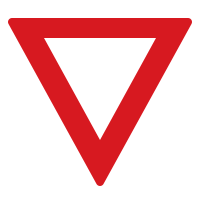
2. What does this inverted triangle tell you?
- • Traffic on the major road must give way to you
- ✓ Give way to traffic on the major road
- • Give way only to vehicles on your right
- • Stop completely even if the road is clear
Answer : Slow down and let traffic on the main road pass; stop if you must.
Uganda Highway Code — road signs (Traffic and Road Safety Act, s. 41(1)(b))
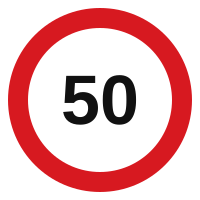
3. What does this sign mean?
- • Maximum speed 50 km/h for lorries only
- • Recommended speed 50 km/h
- ✓ Maximum speed 50 km/h
- • Minimum speed 50 km/h
Answer : A number inside a red ring is the maximum speed for that stretch of road.
Uganda Highway Code — road signs (Traffic and Road Safety Act, s. 41(1)(b))

4. What does this sign mean?
- ✓ No parking
- • No waiting during rush hours only
- • Parking for taxis only
- • No stopping at all
Answer : Blue disc, red ring, one bar: you may stop briefly but must not park.
Uganda Highway Code — road signs (Traffic and Road Safety Act, s. 41(1)(b))
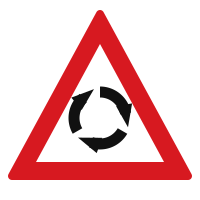
5. What does this warning sign mean?
- • Crossroads ahead
- • U-turn ahead
- • Mandatory roundabout: go round now
- ✓ Roundabout ahead
Answer : A roundabout is ahead: slow down, pick your lane, give way to traffic from the right.
Uganda Highway Code (Ministry of Works and Transport) — rules of the road
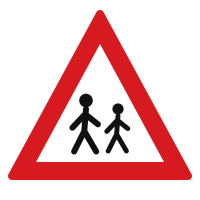
6. What does this sign warn of?
- • A pedestrian crossing ahead
- • A playground: no stopping
- ✓ Children — school nearby
- • Elderly people crossing
Answer : Children may run into the road; slow right down.
Uganda Highway Code — road signs (Traffic and Road Safety Act, s. 41(1)(b))
7. Before getting a learner’s licence for a car (Group B), you must normally be:
- • 16 or older, with a medical certificate
- • 18 or older; no medical certificate needed
- • 21 or older, with a medical certificate
- ✓ 18 or older, with a medical certificate
Answer : Section 38(1): at least 18, certified by a medical practitioner as fit, and instructed by a licensed instructor.
Traffic and Road Safety Act, 1998 (Cap. 361), s. 38(1)
8. Your licence expired more than two years ago. To renew it you must:
- • Just pay the renewal fee and a fine
- • Bring a new medical certificate only
- • Sit the theory test only
- ✓ Sit the theory and practical tests again
Answer : Not renewed within two years of expiry: you must redo theory and practical tests, and pay a fee and fine (s. 42(4)).
Traffic and Road Safety Act, 1998 (Cap. 361), s. 42(4)
9. Driving with alcohol above the prescribed limit can be punished by:
- • Up to 100 currency points and/or 1 year
- • Up to 50 currency points
- • Up to 150 currency points and/or 6 months
- ✓ Up to 300 currency points and/or 3 years in prison
Answer : Section 111(1): fine up to 300 currency points (UGX 6 million) or up to 3 years, or both; the vehicle may be impounded.
Traffic and Road Safety Act, 1998 (Cap. 361), s. 111
10. Using a hand-held mobile phone while driving is:
- • Allowed with one hand on the wheel
- • Allowed in traffic jams
- ✓ Reckless driving under the Act
- • Careless driving, with a small fine
Answer : Section 108(7)(f) lists using a hand-held mobile phone while driving as reckless driving.
Traffic and Road Safety Act, 1998 (Cap. 361), s. 108(7)
11. How many passengers may a boda boda carry?
- ✓ One
- • Two
- • Two if one is a child
- • Three if they are small
Answer : Not more than one person in addition to the rider, on a proper seat securely fixed (s. 127(1)).
Traffic and Road Safety Act, 1998 (Cap. 361), s. 127(1)
12. A goods vehicle may not carry a load greater than:
- • 10% more than the manufacturer’s figure
- • The load the owner declares
- • Whatever the police allow
- ✓ The load specified by the chassis manufacturer
Answer : Section 104(1): load limited to what the chassis manufacturer specifies.
Traffic and Road Safety Act, 1998 (Cap. 361), s. 104(1)
13. A speed limit is:
- • A recommended speed
- • A minimum speed
- • The speed you should keep
- ✓ The maximum allowed, not a target
Answer : Driving over the prescribed limit is reckless driving (s. 108(7)(a)); slow down further when conditions require.
Traffic and Road Safety Act, 1998 (Cap. 361), s. 108(7)(a)
14. In Uganda vehicles keep to:
- • The left side, except on highways
- ✓ The left side of the road
- • The centre on two-way roads
- • The right side of the road
Answer : Keep left except when overtaking or turning right.
Uganda Highway Code (Ministry of Works and Transport) — rules of the road
15. At a roundabout you give way to:
- • Traffic from your left
- ✓ Traffic coming from your right
- • The larger vehicle
- • Traffic going straight on
Answer : Vehicles already on the roundabout, coming from the right, go first.
Uganda Highway Code (Ministry of Works and Transport) — rules of the road
16. A pedestrian is on a zebra crossing. You must:
- • Give way only to children
- ✓ Stop and let them cross
- • Hoot and pass if there is room
- • Pass behind them
Answer : Stop for pedestrians on a crossing; not doing so is reckless driving (s. 108(7)(i)).
Traffic and Road Safety Act, 1998 (Cap. 361), s. 108(7)(i)
17. When should you dip your headlights?
- • Only when flashed
- ✓ When meeting or following other vehicles
- • Never on highways
- • Only in Kampala
Answer : Full beam dazzles; dip for oncoming traffic and when following closely.
Uganda Highway Code (Ministry of Works and Transport) — rules of the road
18. You are involved in an accident. You must:
- • Call your insurer first
- ✓ Stop if safe, check for injured people and give all practicable help
- • Drive on and report later
- • Move the vehicles before checking anyone
Answer : Section 125(1): stop if reasonably safe, find out if anyone is hurt and render all practicable assistance.
Traffic and Road Safety Act, 1998 (Cap. 361), s. 125(1)
19. At an unguarded railway level crossing you must:
- • Stop only if a train is visible
- • Cross quickly
- • Slow down only
- ✓ Stop clear of the line and check that it is clear
Answer : Section 124(1): stop clear of the line long enough to make sure no train is coming.
Traffic and Road Safety Act, 1998 (Cap. 361), s. 124(1)