Driving theory test — Kenya (2026): format, pass mark and free practice
What you need to know to pass the theory test (Kenya) the first time, plus 19 practice questions with answers.
Take the free testThe test
NTSA test: road signs, Highway Code questions and the model town board.
50 questions. You need 40 correct answers to pass.
The exact format is not officially published: these figures are indicative, based on public information.
- Fail and you pay to re-book your test (KES 1,050) and wait for a new date.
- Learn the rules once, properly — and keep your licence clean.
Topics to revise
ITOZE’s 162 questions for this country cover:
- Road signs (47)
- Rules of the road (26)
- Alcohol and behaviour (14)
- Demerit points (13)
- Breakdowns and accidents (13)
- Vehicle and loads (11)
- Licensing (10)
- Speed (10)
- Lights and horn (7)
- Police and signals (6)
- Motorcycles (5)
How to prepare
- Start with a test to see where you stand.
- Revise topic by topic, reading the explanation of every mistake.
- Take at least 3 full mock exams in the real format before the day.
Frequently asked questions
How many questions are in the theory test (Kenya)?
NTSA test: road signs, Highway Code questions and the model town board. The exact format is not officially published: these figures are indicative, based on public information.
What score do you need to pass?
40 correct answers out of 50.
How can I practise for free?
On itoze.com/ke: 5 questions without signing up, then one full mock exam for free, in the real format and marked against the same pass mark.
How much does ITOZE cost?
3 days : 50 KES · 1 week : 100 KES · 1 month : 250 KES. Pay by mobile money: Safaricom.
What if I fail my test?
With a 1-week or 1-month subscription and at least 3 mock exams taken on ITOZE, you get your money back on a photo of your result (terms: itoze.com/ke/guarantee).
Where do the questions come from?
Questions derived from the Traffic Act (Cap. 403) of Kenya, its demerit-points schedule and the Kenya Highway Code.
19 practice questions with answers
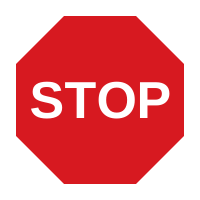
1. What must you do at this sign?
- • Slow down and proceed if clear
- • Hoot and proceed
- ✓ Stop at the line and go only when the road is clear
Answer : A STOP sign means a full stop at the line. Failing to obey a stop sign or red light carries 6 demerit points.
Kenya Highway Code — road signs (Traffic Act s. 52(1)(b), s. 70)
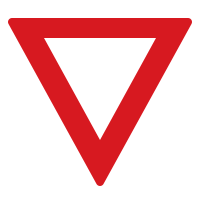
2. What does this inverted triangle mean?
- • Stop in all cases
- ✓ Give way to traffic on the main road
- • You have priority
Answer : Slow down and give way to traffic on the road you are entering; stop if necessary.
Kenya Highway Code — road signs (Traffic Act s. 52(1)(b), s. 70)
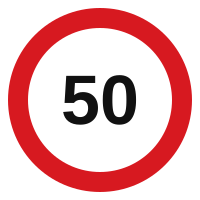
3. What does this sign mean?
- ✓ Maximum speed 50 km/h
- • 50 metres to a bump
- • Minimum speed 50 km/h
Answer : 50 km/h is the general limit inside any trading centre, township, municipality or city (s. 42(3)).
Traffic Act (Cap. 403), s. 42(3)
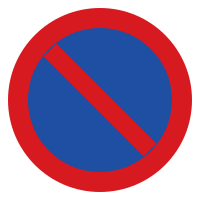
4. What does this sign mean?
- • Matatu stage
- ✓ No parking
- • No stopping
Answer : Blue disc, red ring, one diagonal bar: no parking. You may stop briefly to pick up or drop off.
Kenya Highway Code — road signs (Traffic Act s. 52(1)(b), s. 70)
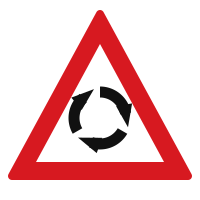
5. What does this warning sign mean?
- ✓ Roundabout ahead
- • Turn back
- • Detour ahead
Answer : A roundabout is ahead: slow down, choose your lane early and give way to traffic from your right.
Kenya Highway Code (Traffic Act s. 68) — rules of the road
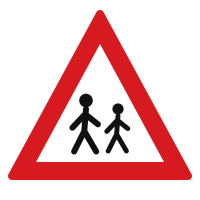
6. What does this sign warn of?
- ✓ Children — school nearby
- • A clinic
- • A playground
Answer : Near nursery, primary or secondary schools you must not exceed 50 km/h (s. 42(3A)) — slower if needed.
Traffic Act (Cap. 403), s. 42(3A)
7. What is the minimum age for a driving licence for a car in Kenya?
- • 16 years
- • 21 years
- ✓ 18 years
Answer : No licence may be granted under 18, except for motorcycles (s. 33(1)(b)).
Traffic Act (Cap. 403), s. 33(1)
8. What can happen if you drive under the influence of alcohol beyond the limit?
- ✓ Fine up to KES 100,000 and/or up to 2 years in jail, plus 12 months’ disqualification
- • A warning only
- • A KES 500 fine
Answer : Section 44: fine up to KES 100,000 or 2 years, or both, and disqualification for 12 months.
Traffic Act (Cap. 403), s. 44
9. A uniformed police officer signals you to stop. You must:
- • Flash your lights
- ✓ Stop
- • Slow down and continue
Answer : Drivers must obey directions of a uniformed police officer and stop when required (s. 52(1)(a),(c)).
Traffic Act (Cap. 403), s. 52(1)
10. Unless signs show otherwise, the speed limit inside a town, municipality or city is:
- • 80 km/h
- • 100 km/h
- ✓ 50 km/h
Answer : No one may exceed 50 km/h on any road within a trading centre, township, municipality or city (s. 42(3)).
Traffic Act (Cap. 403), s. 42(3)
11. A vehicle may be used on the road only if:
- • It is new
- • It is painted
- ✓ Its parts, including lights and tyres, are in a safe condition
Answer : All parts and equipment, including lights and tyres, must be maintained so that driving is not dangerous (s. 55(1)).
Traffic Act (Cap. 403), s. 55(1)
12. A matatu carries more passengers than licensed. Who commits an offence?
- ✓ The driver, the conductor and the owner
- • Only the passengers
- • Nobody
Answer : Each of the driver, conductor and owner commits an offence, plus KES 5,000 per extra person (s. 100(2)).
Traffic Act (Cap. 403), s. 100(2)
13. On a boda boda, who must wear a helmet and a reflective jacket?
- • Only the rider
- ✓ Both the rider and the passenger
- • Only the passenger
Answer : No person, including a passenger, may ride on a motorcycle without a helmet and a jacket with reflectors (s. 103B(1)).
Traffic Act (Cap. 403), s. 103B(1)
14. In Kenya you drive on:
- ✓ The left side of the road
- • The middle
- • The right side
Answer : Keep left, except when overtaking or turning right.
Kenya Highway Code (Traffic Act s. 68) — rules of the road
15. At a roundabout you normally give way to:
- • Nobody
- • Traffic from your left
- ✓ Traffic coming from your right
Answer : Traffic already on the roundabout, coming from the right, has priority.
Kenya Highway Code (Traffic Act s. 68) — rules of the road
16. A pedestrian has started crossing at a zebra crossing. You must:
- • Pass behind them
- • Hoot to hurry them
- ✓ Stop and let them cross
Answer : Give way to pedestrians on a zebra crossing. Breaching crossing rules: 4 demerit points.
Traffic Act (Cap. 403), Schedule to s. 117A (demerit points)
17. A broken-down vehicle left on the road at night (6.45 pm – 6.15 am) must:
- • Have its doors open
- • Be left dark
- ✓ Show lights visible from both directions
Answer : Between 6.45 p.m. and 6.15 a.m. its position must be indicated by lights visible from either direction (s. 53(2)).
Traffic Act (Cap. 403), s. 53(2)
18. Your vehicle breaks down and obstructs the road. You must place warning signs:
- ✓ At least 50 metres in front and behind the vehicle
- • On the roof
- • 5 metres behind
Answer : Section 53(3): place the prescribed reflecting triangles not less than 50 m in front of and behind the vehicle.
Traffic Act (Cap. 403), s. 53(3)
19. You are involved in an accident causing injury or damage. You must:
- ✓ Stop and give your name, address and vehicle details if asked
- • Drive away
- • Wait for the insurer only
Answer : Section 73(1): stop and give your name, address, the owner’s name and the vehicle identification if required.
Traffic Act (Cap. 403), s. 73(1)